Browse by Topics
- English Worksheets
- Science Worksheets
- Kid's Corner
- Numbers & Operations
- Addition
- Subtraction
- Multiplication
- Division
- Decimals
- Place Value
- Roman Numerals
- Skip Counting
- Odd & Even Numbers
- Patterns
- Cardinal & Ordinal Numbers
- Rounding Numbers
- Estimation of Numbers
- Estimation of Time & Money
- Counting & Cardinality
- Comparing Numbers
- Ordering Numbers
- Fractions
- Prime & Composite Numbers
- Squares & Cubes
- Square & Cube Root
- Divisibility Rules
- Factors & Multiples
- Data Handling
- Algebra
- Ratio
- Least Common Factor
- Greatest Common Factor
- Percent Worksheets
- Proportion
- Order of Operations
- Scientific Notation
- Exponents
- Algebraic Expressions
- Evaluating Algebraic Expressions
- Simplifying Algebraic Expressions
- Graphing Lines
- Point Slope Form
- Two Point Form
- Two Intercept Form
- Equations
- Identifying Functions
- Evaluating Functions
- Function Table
- Domain and Range
- Trigonometric Charts
- Quadrants
- Polynomials
- Measurement
- Geometry
- Word Problems
Measuring Angles worksheets
Download free printable measuring angles worksheets PDF with answers. These worksheets help students practice reading a protractor, measuring acute, obtuse, right, straight, and reflex angles, and drawing angles accurately for grades 4–6.
It is an important skill in geometry that helps us understand the size and direction of turns or corners. Whether you’re working on a school project, designing something, or solving real-world problems, knowing how to measure angles correctly is essential.
To begin, always identify the type of angle you’re dealing with—acute, right, obtuse, or reflex. Recognizing the angle type will help you estimate the measurement before using any tools. This step can save time and improve accuracy.
Next, use a protractor to measure the angle. Place the midpoint of the protractor on the angle’s vertex, and align one side of the angle with the baseline. Then, read the number on the scale where the other side of the angle points. Remember to use the correct scale based on the direction of the angle.
Using a protractor in an anticlockwise direction:
- This is measurement in anticlockwise direction. Thus, we will use the inner scale to measure the angle.
- The centre of the protractor is placed on the vertex B of the angle ABC. The base line of the protractor should coincide with the base BC of the angle.
- Read the markings where the arm BC overlaps the markings on the protractor. That measurement is the measure of the angle.
- Therefore, the angle ABC measures 45°

Measuring Angles worksheets free download pdf
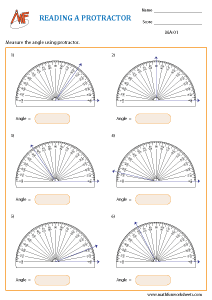
Reading Protractor - Inner scale
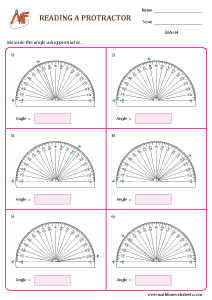
Reading Protractor - Inner and Outer scale
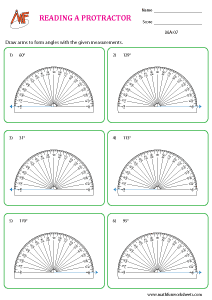
Draw arms to form angles
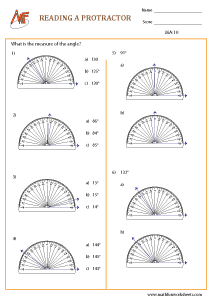
Measure of the angle
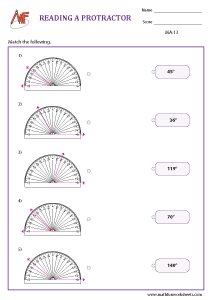
Match the following
Match the following
Measure the given inner angles
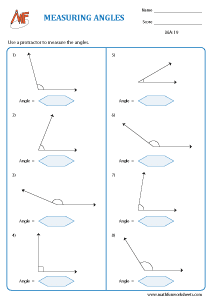
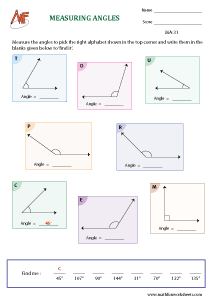
Measure angles using protractor
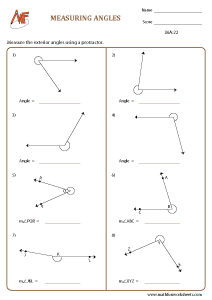
Measure exterior angles using protractor
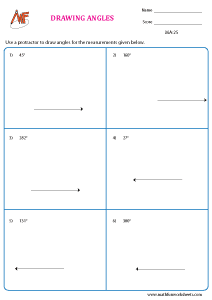
Draw angles using protractor
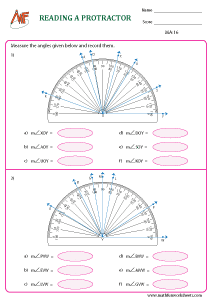
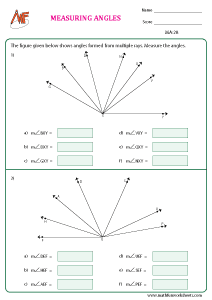
Measure angles formed by multiple rays
Measuring angles - Puzzle
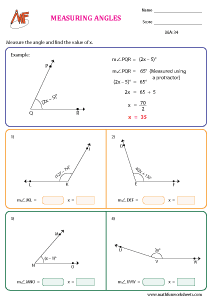
Find the variable
Find the variable
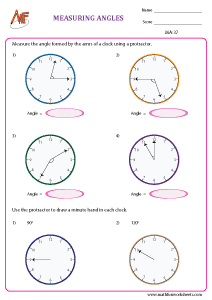
Angles formed by clocks
Download all measuring angles worksheets PDF with answers and practice reading a protractor, measuring acute, obtuse, right, straight, and reflex angles, and drawing angles accurately. These free printable worksheets help students build confidence in geometry.
Related Angles Worksheets
Frequently Asked Questions
Place the center on the vertex, align one ray with the baseline, and read the degree measure on the correct scale.
The inner scale is used when measuring from the left baseline, while the outer scale is used when measuring from the right baseline.
Measuring angles is typically introduced in grades 4–6.
Yes, the worksheets include answer keys for practice and assessment.
Yes, the worksheets include activities for drawing and measuring angles with a protractor.