- Home
- Measurement
- Measuring Capacity
Browse by Topics
- English Worksheets
- Science Worksheets
- Kid's Corner
- Numbers & Operations
- Addition
- Subtraction
- Multiplication
- Division
- Decimals
- Place Value
- Roman Numerals
- Skip Counting
- Odd & Even Numbers
- Patterns
- Cardinal & Ordinal Numbers
- Rounding Numbers
- Estimation of Numbers
- Estimation of Time & Money
- Counting & Cardinality
- Comparing Numbers
- Ordering Numbers
- Fractions
- Prime & Composite Numbers
- Squares & Cubes
- Square & Cube Root
- Divisibility Rules
- Factors & Multiples
- Data Handling
- Algebra
- Ratio
- Least Common Factor
- Greatest Common Factor
- Percent Worksheets
- Proportion
- Order of Operations
- Scientific Notation
- Exponents
- Algebraic Expressions
- Evaluating Algebraic Expressions
- Simplifying Algebraic Expressions
- Graphing Lines
- Point Slope Form
- Two Point Form
- Two Intercept Form
- Equations
- Identifying Functions
- Evaluating Functions
- Function Table
- Domain and Range
- Trigonometric Charts
- Quadrants
- Polynomials
- Measurement
- Geometry
- Word Problems
Measuring Capacity Worksheets
Measuring capacity worksheets help students learn how to measure, compare, estimate, and convert liquid volume. These free printable worksheets cover metric units such as milliliters and liters and customary units such as cups, pints, quarts, and gallons. Students can practice choosing appropriate units and solving practical capacity measurement problems.
Students can use these capacity worksheets to develop measurement skills through real-life examples involving containers, measuring jugs, cylinders, and liquids. The activities range from simple comparisons and estimates to more challenging measurement and conversion problems.
Over 40 free printable worksheets are available in easy PDF format. Download and practice.

Measuring Capacity Worksheets free download pdf
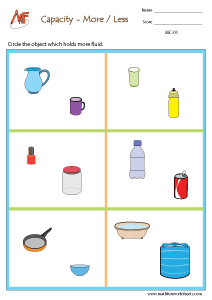
Capacity measurement - more / less
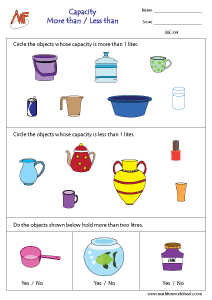
Capacity measurement - more than / less than (Metric unit)
Capacity measurement - more than / less than(Customary unit)
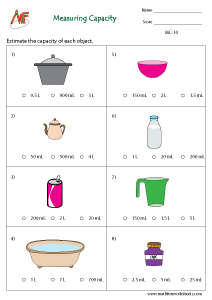
Estimate the capacity (Metric unit)
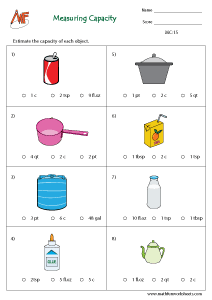
Estimate the capacity (Customary unit)
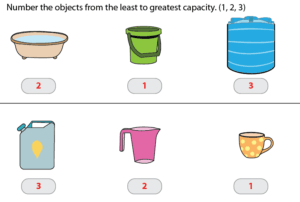
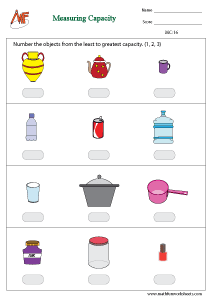
Ordering the objects based on capacity
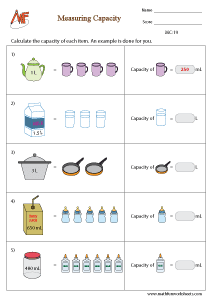
Calculate the capacity of each item (Metric unit)
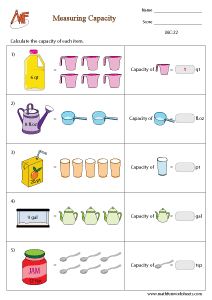
Calculate the capacity of each item (Customary unit)
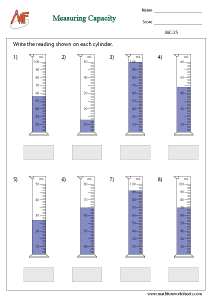
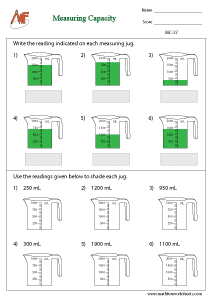
Measuring cylinder (Easy)
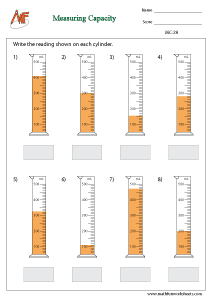
Measuring cylinder (Medium)
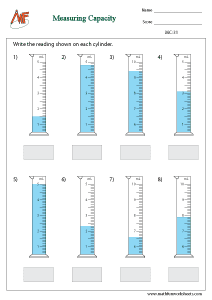
Measuring cylinder (Hard)
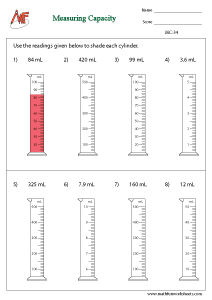
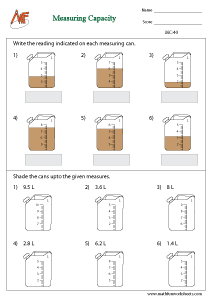
Mark the reading on cylinder
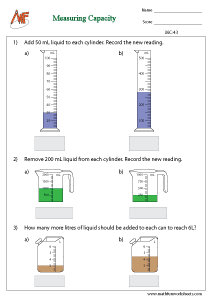
Measure after adding/removing liquid
Students can strengthen their measurement skills with our Measurement of Length Worksheets, Measuring Weight Worksheets, Measurement of Time Worksheets, and Temperature Worksheets. For additional practice with liquid volume and unit conversions, explore our Metric and Customary Units of Capacity Worksheets. These related resources help students compare measurements, choose appropriate units, and solve practical measurement problems.
In addition, many worksheets include word problems. These encourage students to apply their knowledge to solve real-world challenges. For example, they may calculate how much lemonade is needed for a party. These problems boost critical thinking and problem-solving skills.
Related Worksheets
Frequently Asked Questions
Capacity is the amount of liquid that a container can hold. It is commonly measured using units such as milliliters, liters, cups, pints, quarts, and gallons.
Common metric units of capacity include milliliters and liters.
Common customary units include cups, pints, quarts, and gallons.
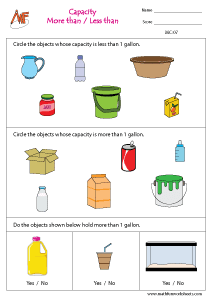
These worksheets help students compare, estimate, measure, and calculate liquid capacity using metric and customary units.
The worksheets are suitable for elementary students and can be used for classroom practice, homework, assessment, and review.